
You knew this one was coming, right?
Perhaps one of the most analyzed modern poems, "This is Just to Say" leaves great room for interpretation. Critics have assumed everything from uselessness, to regret, to sexual frustration as key themes. Some wonder whether the poem is a poem at all. Some claim it was a note scribbled on a napkin left for his wife to find, others question its poetic backbone because, aside from all the lines looking the same aesthetically, the compilation of words is void of discernible metrical form.
Welcome to the world of poetic analysis.
I hope you'll allow me to take you as far away from this world as possible.
There was a time in my life when analyzing poetry was part of the deal. Academia often relies on a more technical form of interpretation, and any good student is expected to know her metrical units (do trochaic, anapaestic and dactylic pentameters sound familiar?).
Once upon a time I could read a poem and point to these distinctions, but I find that now, years out of school and with little use for these terms today, I'm much more interested in the emotional current of a poem than whether or not it has five or seven syllables per line. Let's have a read and see what you think.
This is Just to Say
by William Carlos Williams
I have eaten
the plums
that were in
the icebox
and which
you were probably
saving
for breakfast
Forgive me
they were delicious
so sweet
and so cold

Personally, I like the idea that Williams left a note for his wife. He ate the plums, regretted it only enough to crack a smile as he was writing said note, then proceeded to take a walk and get on with the morning.
"That you were probably saving for breakfast" reveals a certain intimacy, too, because the speaker assumed a purpose for the plums based on what he knew of his wife. Had he not devoured them, she would have eaten them herself that morning.
From the mind of someone who once thought in verse, this is the kind of poem that just comes to you when it comes. You write it down, walk away, and there it is. You don't force it into a form. You just want it to sound pleasing to the ear and be what it was meant to be: an honest response to a moment in time.
This is the stuff of life. We eat plums our spouse might have been saving. We forget to take out the trash until we can smell the onion peels. We cook together, eat together.
It might be as simple as this: A little poem about eating plums is too delicious to spend that much time thinking about. Over-analyzing removes the joy we receive from reading these words, smiling, and imagining how perfectly ripe those plums must have tasted.
I don't think Williams set out to write this poem before tasting the plums. I think the fact that they were "so delicious and so cold," and perhaps so much better than he may have assumed they would be, prompted him to realize that they truly were special enough to apologize for taking.
What I'm trying to say is who cares about what this poem really means. It means whatever you want or need it to. Whatever you feel upon reading it is accurate. Stop thinking. Just eat the plums while they're still in season. (Sound good? Give it a tweet!)


INA'S PLUM TATIN
Recipe lightly adapted from Ina Garten
Don't omit the extra step of lining the cake pan with parchment paper. It will help ensure the plums don't stick to the bottom. I ended up being low on all-purpose flour the day I baked this, and used half spelt instead. The results were wonderful.
6 tablespoons (3/4 stick) unsalted butter; room temperature
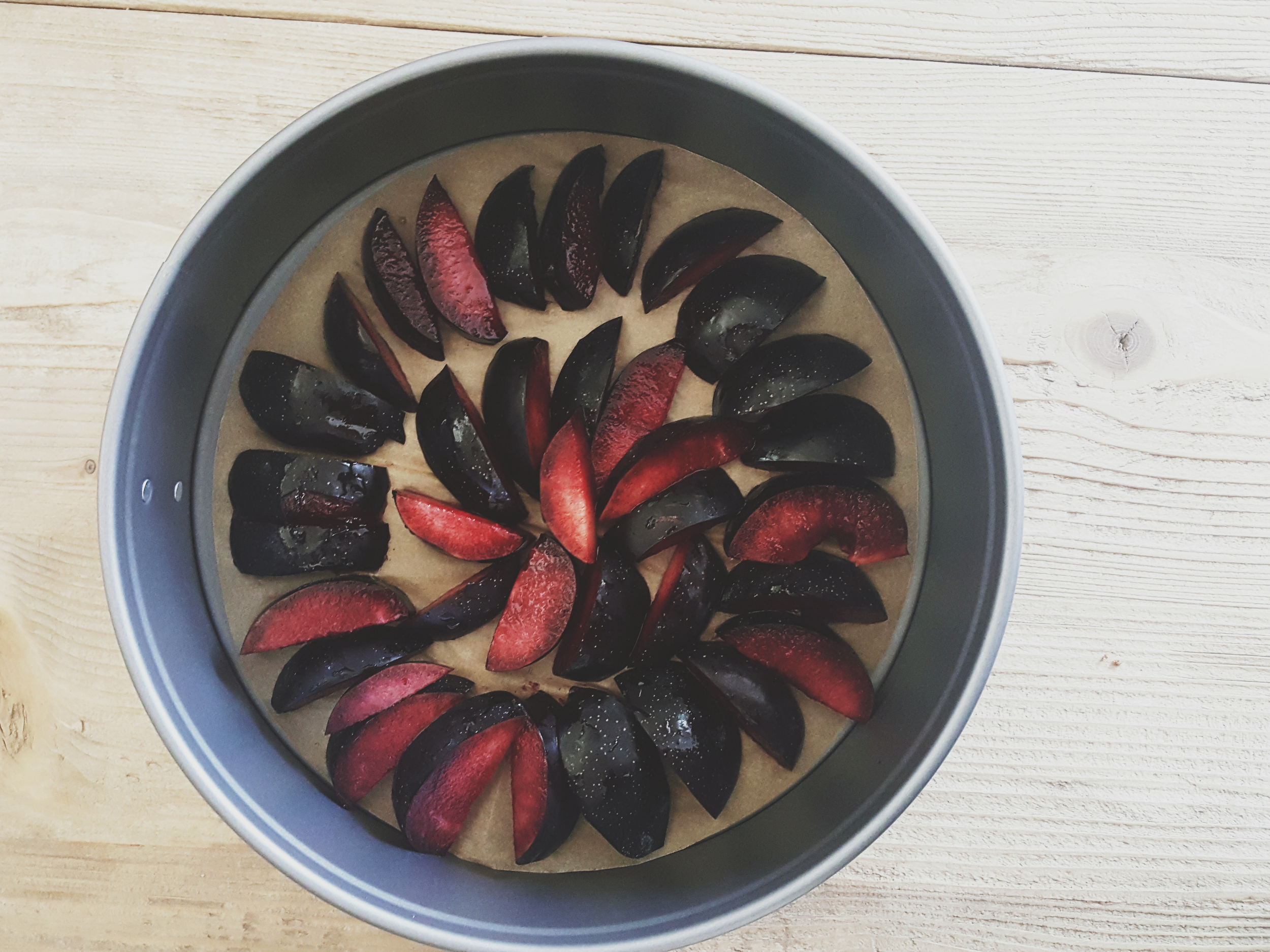
1 pound plums, pitted and sliced into 1/2-inch pieces (about 5 to 6)
1 3/4 cups granulated sugar, divided
2 large eggs, at room temperature
1/3 cup sour cream
1/2 teaspoon grated lemon zest
1/2 teaspoon pure vanilla extract
1 cup plus 2 tablespoons all-purpose flour
1/2 teaspoon baking powder
1/4 teaspoon kosher salt
Whipping cream, for serving
Preheat the oven to 350°F and line a 9-inch springform pan with parchment paper.
Combine 1 cup of the sugar and 1/3 cup water in a small saucepan. Cook over high heat, until it turns a warm amber color and registers about 360°F on a candy thermometer. Swirl the pan, and pour evenly over the plums.
While the caramel bubbles, cream the butter and remaining 3/4 cup of sugar in the bowl of a stand mixer fitted with the paddle attachment until light and fluffy, about 3 minutes. On low speed, beat in the eggs one at a time, then add the sour cream, zest, and vanilla. Stir the flour, baking powder, and salt in a small bowl, then add it to the mixer while on low speed; mix until just combined.
Pour the cake batter evenly over the plums and bake for 30 to 40 minutes, until a cake tester comes out clean. (My cake was perfect at 35 minutes) Cool for 20 minutes, then invert the cake onto a flat plate and remove the parchment paper. Serve warm or at room temperature, with a dollop of whipped cream.
