
"Under the earth the miracle happened."
Consider the onion. You probably have a bowl of them in your pantry, or one or two tucked next to the glossy tomatoes or near the garlic. They wait where we leave them, to be peeled and minced, to give a backbone to our next recipe. All this without the fanfare or praise or notoriety we give to others, sometimes purely on the basis of aesthetics. Figs, melted chocolate, well-styled cheese platters and fizzy cocktails come to mind. The onion, by comparison, is plain and ordinary.
But Pablo Neruda knew a little something about the ordinary, so much so that he wrote an entire series of odes in praise of objects or foods we pass by in our lives without ever giving attention to, like chairs or tables, even mayonnaise. Today, the onion.
ODE TO THE ONION
by Pablo Neruda
Onion,
luminous flask,
your beauty formed
petal by petal,
crystal scales expanded you
and in the secrecy of the dark earth
your belly grew round with dew.
Under the earth
the miracle
happened
and when your clumsy
green stem appeared,
and your leaves were born
like swords
in the garden,
the earth heaped up her power
showing your naked transparency,
and as the remote sea
in lifting the breasts of Aphrodite
duplicating the magnolia,
so did the earth
make you,
onion
clear as a planet
and destined
to shine,
constant constellation,
round rose of water,
upon
the table
of the poor.
You make us cry without hurting us.
I have praised everything that exists,
but to me, onion, you are
more beautiful than a bird
of dazzling feathers,
heavenly globe, platinum goblet,
unmoving dance
of the snowy anemone
and the fragrance of the earth lives
in your crystalline nature.
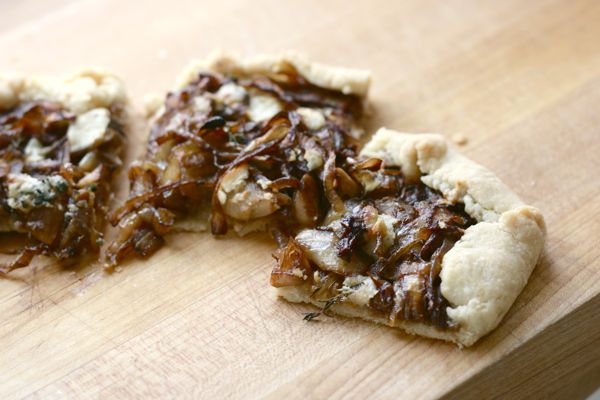
It's lovely, isn't it? I could speak at length about the lyrical language, the way the onion is described as clear as a planet, how Neruda dances around its layers and peels them away, describing every piece of the onion's humble existence. (I will say, however, that my gut would rather the poem stop after the first stanza, ending with "upon the table of the poor.") But when I re-read the poem, I just stopped at the end, sighed, and didn't want to say any of that, really. I just want the poem to be here, with a slice of this tart nearby.
ONION GALETTE WITH BLUE CHEESE & HONEY
Not many ingredients, here, just a lot of onions and a little crumble of cheese. I've used Ina Garten's tart recipe for a while now, and am very happy with it, so the dough is hers.
For the tart
1 1/2 cups all-purpose flour
Kosher salt
1 1/2 sticks unsalted butter
3 to 4 tablespoons ice water
For the filling
2 tablespoons extra-virgin olive oil
4 large onions, thinly sliced
2 garlic cloves, minced
About 1 teaspoon minced thyme
2 tablespoon balsamic vinegar
Blue cheese, crumbled
Honey, for serving
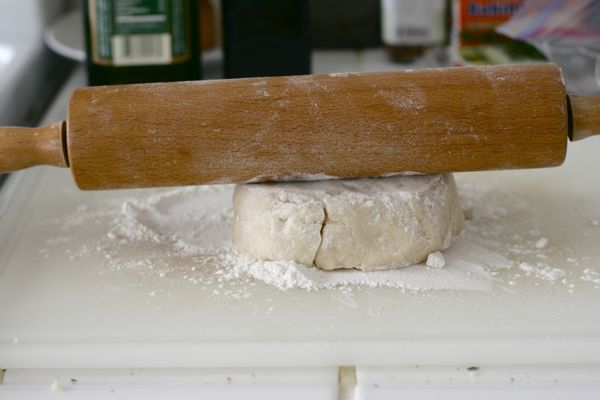
Make the tart crust. Add the flour and 1/4 teaspoon salt to the bowl of a food processor. Cut the butter into small pieces and add it to the bowl. Pulse until the butter is the size of peas. With the machine running, add the ice water and process until the dough crumbles, but don't overprocess. Dump the dough onto a floured board and gather it into a ball. Cover with plastic wrap and refrigerate for at least 30 minutes.
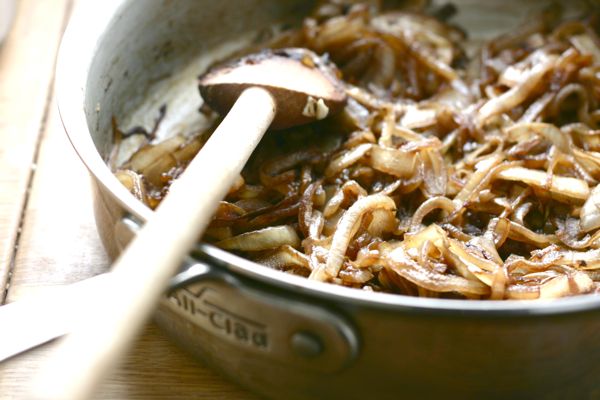
While the dough rests, heat the oil in a large skillet over low heat. Add the onions, garlic, thyme, balsamic, and season with salt and pepper. Stir to combine and cook for 30-40 minutes, stirring occasionally, until the onions are deeply caramelized.
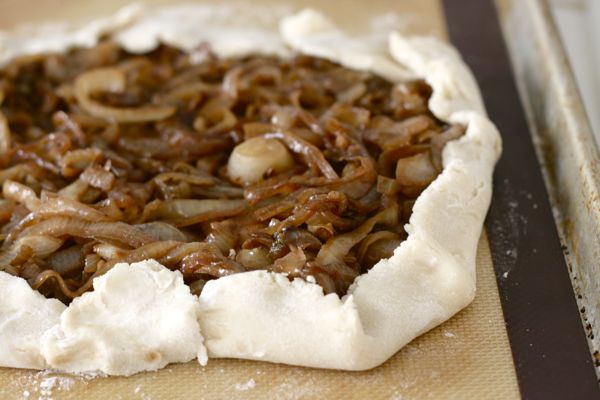
Heat the oven to 350 degrees. After the dough has chilled, roll it out on a well-floured cutting board into a large circle (it doesn't have to be perfect), and place it on a parchment or silpat-lined baking sheet. Spread the onions from the center to the edges. Leave about an inch border and fold the excess dough into the onions. Sprinkle some blue cheese over the top and bake anywhere between 25-35 minutes, until the edges are golden brown and the cheese has melted. Serve with a drizzle of honey.
