Life & Thyme Excerpt: A Virtuous Fish

Photo by Josh Telles

Photo by Josh Telles


Note: This story was originally published in Issue One of Life & Thyme. To read the full feature in its entirety, purchase Issue One from the online shop or from one of their local stockists.


The Purveyor

It’s 5:12 a.m. Behind a thick panel of plastic curtains, fish bones are ripped out under fluorescent lights and blood smears on plastic cutting boards. I’m standing in a small puddle next to Alfredo Gurrola, one of the most sought-after seafood purveyors in Los Angeles, marveling at the pink tuna bellies standing at attention on nearby table, awaiting their fate.

With scales splattered on my leather boots, I turn to Gurrola and ask how he chooses fish.

“It’s a combination of learned technique and instinct. Even though you can know why the fish should be one way, or look for clear gills, you must have the feeling. You have to love it.”

What he loves is a market that smells of salt and the faintest wisp of seaweed. Six days a week, Gurrola walks the floor at International Marine Products (IMP) in downtown Los Angeles, overseeing deliveries and meticulously inspecting orders placed by his roster of restaurant clients. Silver mackerel straight as a board is still in rigamortis. Abalone from New Zealand, the size of a grown man’s fist, suctions itself to the interior of a plastic bucket. A  five hundred pound bluefin tuna marked SG—sushi grade—with a red felt pen is unearthed from beneath a tarp.

Photo by Josh Telles

Photo by Josh Telles

In spare moments, Gurrola calls markets on the east coast and sends texts to local chefs with the morning’s updates, like when storms prevent a box of Nantucket bay scallops from arriving on time. It’s a fast-paced, twenty four hour job. Some might buckle at the intensity, but the daily challenges have helped fuel his passion for nearly thirty years.

Growing up in Zacatecas, Mexico, fish was rarely in his mother’s kitchen, and Gurrola softens into a smile when I ask how his role developed from driving a truck for IMP—his first job in 1985—to working directly with chefs and brokers. “I saw how IMP handled the fish, how the chefs prepared it, and the freshness.”

Although his depth of knowledge was cultivated slowly, Gurrola’s confidence can be traced to one memory. Early on, Gurrola was showing an IMP customer a fish he was particularly in love with that day.

“It looked so good, so beautiful,” he recalls. “When I showed it to the chef and explained how the fish was cut, he looked at me and told my boss ‘I want to buy that fish just because I see the passion he has.’”

Gurrola turns away and opens a box of tiger prawns, pulling one up by the tail before it curls its body in protest. The rest remain covered in wood chips.

“To prevent suffocation,” he says, noticing as I lean in closer.


The Chef

For Chef Michael Cimarusti, relationships are as important as the products. He worked with a handful of IMP reps before Gurrola took over the account for his two-Michelin star Hollywood restaurant, Providence, and the two bonded quickly.

“I trusted him immediately,” Cimarusti says. “I know he has his eye on everything that comes to us and understands the quality we’re looking for.”

Years later, Gurrola still insists he is not a salesman.

“I can’t sell fish by talking. My selling point is offering quality.” Cimarusti is quick to interject. “That’s the point! He doesn’t have to sell anything to me. I just know that when I need something, there’s nobody else to get it from.”

Chef Michael Cimarusti and Alfredo Gurrola | Photo by Josh Telles

Chef Michael Cimarusti and Alfredo Gurrola | Photo by Josh Telles

Providence maintains strict sustainability standards and doesn’t mind paying more for wild fish. “It’s a value choice that people need to make,” Cimarusti notes. “When you’re guaranteed the fish is wild and sustainable, there are costs associated with that. Do you want to pay $10 for a piece of grilled salmon that was farm raised irresponsibly in a foreign country and not tested for its wholesomeness, or do you want to buy something wild, that’s keeping American fishermen on the water, that’s being harvested in a sustainable manner?”

This conviction, stemming in part from Cimarusti’s lifelong devotion to fishing, translates into the seasonal menu at Providence. “Whatever we do to the fish here is as important to the experience of our guests as anything else. I tell the cooks all the time, that fish didn’t come all the way from Japan or Australia to be mistreated. Somebody went and pulled that fish out of the ocean and shipped it around the world. It’s incredibly precious. Not only monetarily, but honoring the ingredients. To have it go to waste is a cardinal sin to us.”

Want to read the full story? Find it in Issue One of Life & Thyme.

Literary City Guide | New Haven, CT

College towns are very often a literary traveler's dream, and New Haven is no exception. Angela is a postdoc at Yale (in Applied Physics!), but when she's not studying superconductors, she's exploring New Haven's literary gems, like a bookstore with experimental jazz shows, a coffee shop with the best cookies (and hot chocolate), and a rare manuscript library. 

Stop by to visit New Haven!


Bells Begin Ringing

My favorite weeknight recipe of late.

My favorite weeknight recipe of late.

The day I turned in my second Life and Thyme magazine story, I reorganized all the mason jars in my pantry. Brown paper bags had been piling up with scoops of lentils, various grains of rice, and seeds, and to say there was disorder among them would be an understatement.

When I'm under a deadline it's hard to focus on anything else. I'd spent the previous two weeks writing approximately five drafts and simultaneously neglecting tasks like laundry, dusting, and said pantry. There was also the matter of my day job to contend with.

It was this past Sunday morning. Fresh off a dinner party the night before and with my husband reading through the story one last time, I pulled out the offenders. Pistachios, beluga lentils, oats, plus a few empty jars waiting to be filled. It felt good to finish one task and begin another.

That morning I also browsed quickly through my Twitter feed and discovered a timely quote.

I revise a great deal. I know when something is right because bells begin ringing and lights flash.
— E.B. White
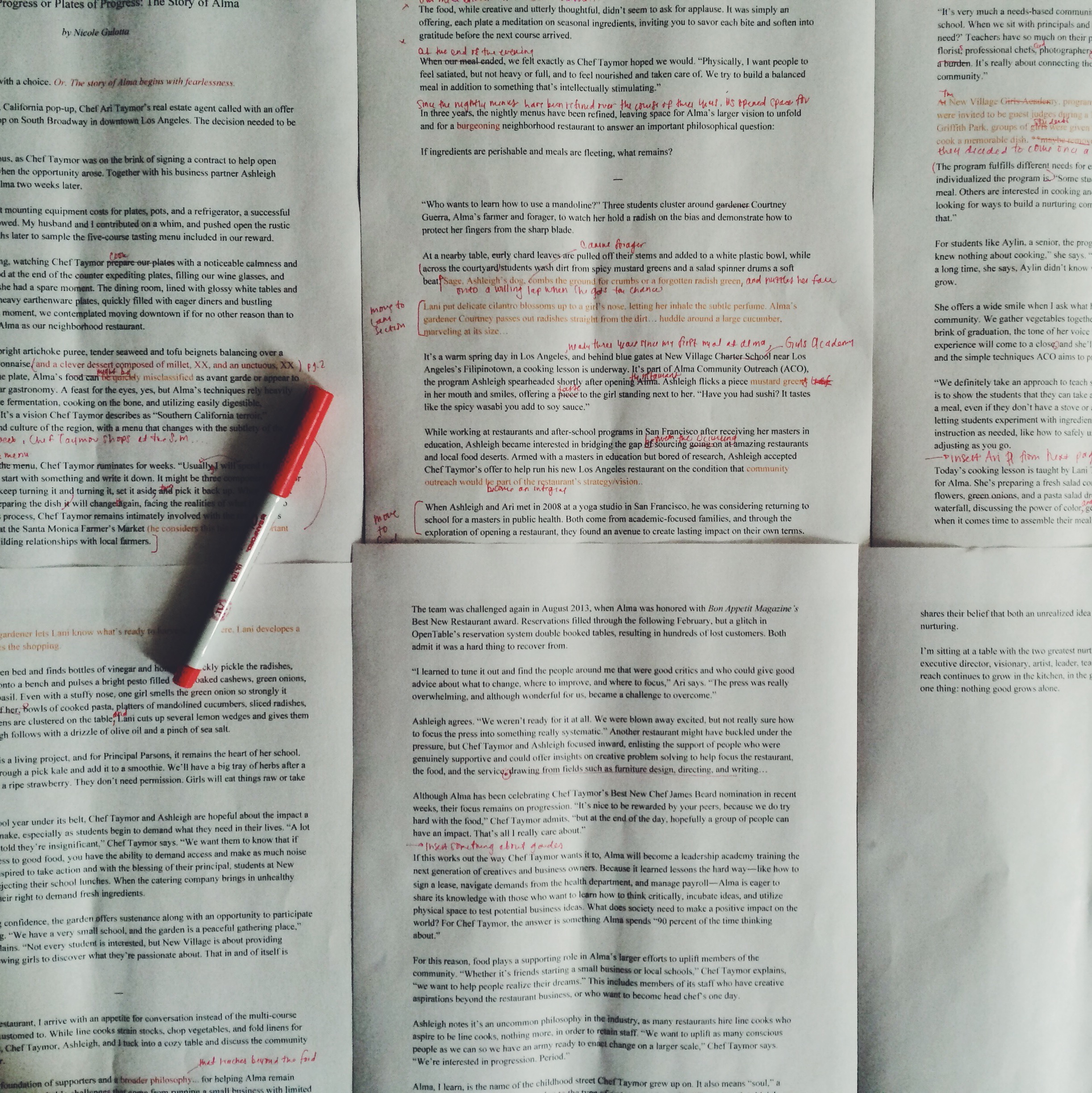
Red pen marks for days.

Red pen marks for days.

I feel this way sometimes, too. You just know when the work is done. You know when it's close, when it needs one more read, when you would be best served by walking away for a few hours, and when it's finally, miraculously good enough.

The same surge of energy I feel at the beginning of a project is usually there at the end, except it's even more satisfying because you've survived the treacherous middle, the "jigsaw puzzle" phase as I like to call it.

Much writing is very much like putting a puzzle together on a rainy day. You open the box and sink a little bit when your eyes lock on 1,000 scattered pieces of a Monet painting. Then you plow forward and do the practical thing: collect all the pieces with an edge.

Our writing needs a framework, and the first draft is like the framed puzzle with nothing in the middle. We know where it's going, the edges are set, we can see the puzzle being completed, but there is still work to be done.

Next we categorize by color. All the blue sky pieces in one corner, the sunlit hills in another. Animals over to one side of the table, and anything questionable clustered on the other side. Then you start putting pieces together section by section, setting them inside the puzzle's frame with a triumphant smile. These are like paragraphs, threaded together and sorted one after the other until the truth is revealed.

You almost believe you will finish. One moment, you do. 

To complete a puzzle, or any writing project, is a momentous occasion. Whether it's a single blog post, a long magazine article, or an entire manuscript, it's worth celebrating once you hear the bells and see the lights flash.

I'll let you know when the magazine comes out this summer. I'm particularly proud of this one, because it's a story close to my heart that's been three years in the making featuring an inspiring new restaurant in Los Angeles. More on that soon! 

Snacks at Alma Restaurant

Snacks at Alma Restaurant


As you might imagine, my cooking for the past few weeks has relied on some tried and true dishes instead of testing new recipes, but I have managed to work a couple of new ones into the mix. 

The First Mess put together a healthy bowl from Sprouted Kitchen's new cookbook. It's the kind of meal that makes you feel really, really good. Healthy, energized, and powerful. During busy weeks, meals like this are essential. Cook a few grains on Sunday (like brown rice and quinoa), and make the dressing, then all you need to do is assemble. I'm in love. 

I've also been eating a lot of panzanella. It's another easy assembly-style dish. 

And a week doesn't go by when there isn't kale salad on the menu (similar to this one). Lately I've been making mine with a bright red wine vinegar and mustard dressing that can stand up to the sturdy leaves. Topped with toasted breadcrumbs and a very healthy dose of Parmesan cheese, it's absolutely perfect. 

The kale salad I can't live without.

The kale salad I can't live without.